
Cost-Plus vs. Fixed-Price: Which Contract Protects You on a Custom Home?
An honest comparison of two construction contract styles, and why experienced homeowners often prefer open-book pricing.
By Matt Noss · November 25, 2026
If you're preparing to build a custom home, one of your biggest concerns is probably protecting yourself financially.
How do you avoid unexpected expenses? How do you know your builder is spending your money wisely? How do you protect your budget?
For many homeowners, a fixed-price contract seems like the obvious answer.
After all, what could be safer than knowing exactly what your home will cost before construction begins?
A cost-plus contract, on the other hand, might sound like you're handing your builder a blank check.
But is it really that simple?
After nearly 20 years in custom home construction, I've learned that your relationship with your builder, the transparency of their pricing and their ability to manage your budget can be far more important than the type of contract you sign.
1. Understanding the Two Contract Styles
Fixed-Price Construction
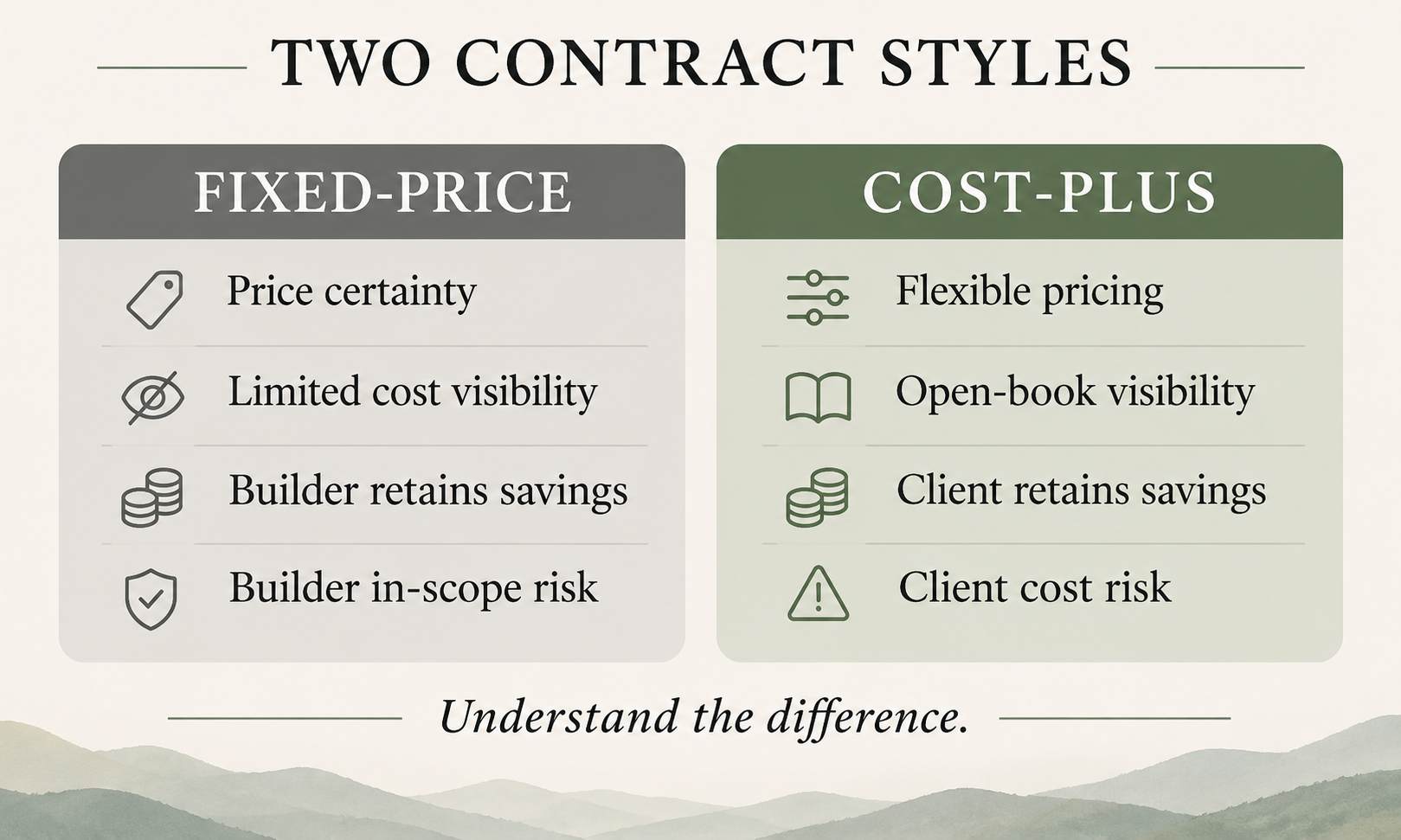
Under a fixed-price contract, your builder agrees to construct your home for a predetermined price based on an agreed set of plans, specifications and scope of work.
The builder estimates construction costs, adds overhead, profit and provisions for financial risk, and presents you with a contract price.
The advantages include:
- Greater initial price certainty.
- Easier financial planning.
- The builder generally assumes the risk of cost overruns within the agreed scope.
- Less involvement in reviewing individual construction expenses.
For homeowners with a clearly defined design and completed selections, this can be an attractive option.
Cost-Plus Construction
Under a cost-plus contract, you pay the agreed allowable costs of constructing your home, plus a builder's fee.
With an open-book approach, you have visibility into the actual expenses associated with your project.
The advantages include:
- Greater financial transparency.
- The opportunity to benefit from construction cost savings.
- Flexibility to make decisions throughout construction.
- A clearer understanding of how your decisions affect your budget.
However, your final construction cost isn't guaranteed. You generally assume more financial risk from unexpected expenses.
A poorly managed cost-plus contract can be just as problematic as a poorly structured fixed-price contract.
2. The Hidden Challenges of Fixed-Price Construction
Who Pays for the Risk?
When a builder commits to a fixed price, they must protect their business against uncertainty.
Material prices may increase. Subcontractor estimates may prove inaccurate. Construction may take longer than anticipated.
A responsible builder accounts for these risks when establishing their price.
You're potentially paying for those risks whether they materialize or not.
If construction costs come in lower than anticipated, those savings generally remain with the builder.
That's not necessarily unfair. It's how the financial arrangement works.
Change Orders Can Be Expensive
One of the joys of building a custom home is having the opportunity to personalize it as it takes shape.
You may walk through your home during framing and realize you want to move a window. You may discover a product you prefer or decide to change the layout of a room.
Under a fixed-price contract, these decisions typically require change orders.
Depending on your agreement, change orders can include substantial markups, administrative fees and additional profit margins beyond the actual cost of the change.
For some builders, change orders become a significant source of additional profit.
The difficulty is that once construction begins, you have limited ability to shop around or negotiate.
You're already committed to your builder.
Allowances, exclusions and unexpected site conditions can also result in additional expenses, depending on your contract.
A fixed price doesn't necessarily mean a fixed final cost.
Are You Working Together or Against Each Other?
This is perhaps my biggest concern with fixed-price construction in a truly custom building environment.
The homeowner naturally wants to receive as much value as possible for the agreed price. The builder has a financial incentive to minimize costs and protect their profit margin.
When disagreements arise over materials, specifications or what the contract includes, both parties can find themselves working to protect their own financial interests rather than working together.
This doesn't mean every fixed-price builder operates this way. However, the contract structure can create an adversarial relationship.
Unfortunately, the homeowner often has less construction knowledge, experience and negotiating leverage than their builder.
I believe building a custom home should be a partnership, not a financial tug-of-war.
3. Same House. Two Different Financial Outcomes.
Imagine your builder estimates that your home will cost $1,000,000 to construct.
For this example, we'll use a hypothetical 20% builder's fee and an additional $50,000 risk provision under the fixed-price arrangement.
| Fixed-Price | Cost-Plus | |
|---|---|---|
| Estimated construction costs | $1,000,000 | $1,000,000 |
| Builder's fee | $200,000 | $200,000 |
| Risk provision | $50,000 | None |
| Initial price or estimate | $1,250,000 | $1,200,000 |
Now consider four possible outcomes.
| Actual construction costs | Fixed-Price Total | Cost-Plus Total |
|---|---|---|
| $950,000 | $1,250,000 | $1,140,000 |
| $1,000,000 | $1,250,000 | $1,200,000 |
| $1,050,000 | $1,250,000 | $1,260,000 |
| $1,150,000 | $1,250,000 | $1,380,000 |
Illustrative figures only. The 20% builder's fee is used for comparison purposes and does not necessarily reflect our actual pricing. This example assumes an unchanged scope and no contractual adjustments to the fixed price.
When construction costs are lower than anticipated, the cost-plus homeowner benefits from the savings.
When construction costs significantly exceed the estimate, the fixed-price homeowner benefits from the builder assuming those additional in-scope costs.
Neither contract is automatically less expensive.
The difference is who assumes the financial risk and who benefits from the savings.
4. Not All Cost-Plus Builders Operate the Same Way
Simply choosing a cost-plus builder doesn't guarantee financial transparency.
You need to understand how your builder earns their money, what their fee includes and what additional charges you might encounter.
At Matt Noss Custom Homes, we've structured our approach around three fundamental principles.
One Percentage. One All-Inclusive Builder's Fee.
Our compensation is based on an agreed percentage of construction costs.
That percentage covers all of our builder services.
There are no hidden charges, additional supervision fees, administrative fees or separate change order fees. We don't receive kickbacks from vendors or retain undisclosed supplier discounts.
If you decide to make a change during construction, you pay the actual cost of that change, plus our agreed percentage.
We don't impose special markups or additional fees simply because you've changed your mind.
Of course, a percentage-based fee means our compensation increases if construction costs increase and decreases if construction costs decrease.
That's why transparency, accountability and trust are so important.
You know exactly how we earn our money, how much we earn and where your construction dollars go.
Total Financial Transparency, 24/7
Our online construction management software gives you access to your project's financial information from start to finish.
You can see your construction budget and actual expenses against each individual line item as they occur.
You don't have to wait for a monthly statement or request an explanation of where your money has gone.
That information is available 24 hours a day, seven days a week.
You shouldn't have to wonder how your builder is spending your money.
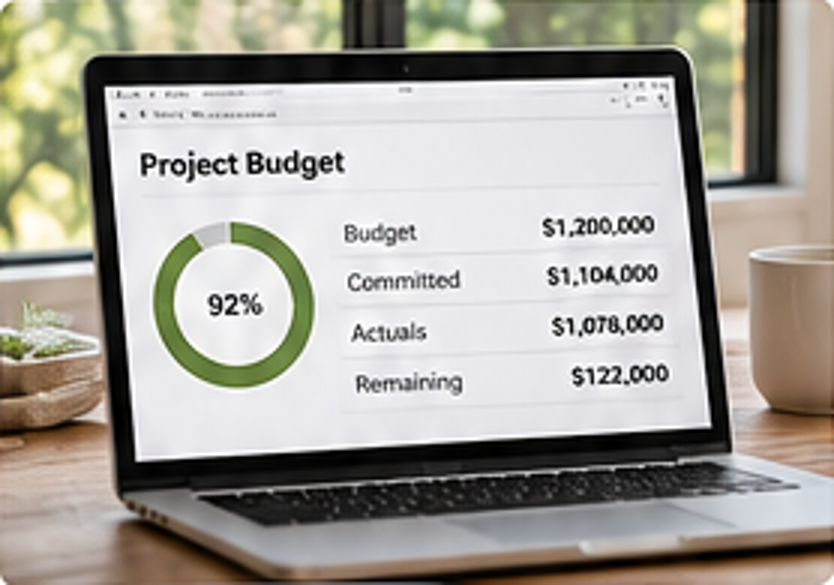
Illustrative budget dashboard, not actual client data or a screenshot of our software.
Our Purchasing Power Becomes Yours
We've spent more than 15 years developing relationships with our suppliers and trade partners.
These relationships allow us to access favorable pricing, which we pass directly on to you.
But their value extends far beyond construction costs.
What happens if you experience a problem after moving into your home?
Our established relationships with reliable trade partners and suppliers are the cornerstone of dependable after-sales service.
The value of a good construction team shouldn't end when you receive the keys to your home.
5. Your Home Should Be a Blessing, Not a Financial Strain
Our approach to budget management has two equally important stages.
Before Construction: Establish Financial Viability
During planning, we have open conversations about your budget and a range of potential financial outcomes.
What happens if construction costs increase? What if your selections are more expensive than anticipated? What if we encounter unexpected site conditions?
Can you comfortably accommodate those possibilities?
These conversations aren't about encouraging you to spend more money. They're about ensuring your project remains financially viable under a range of circumstances.
The last thing I want is for you to move into your dream home only to discover that the financial commitment has become a source of stress.
Your home should be a blessing, not a financial strain.
During Construction: Manage the Budget Proactively
Throughout construction, we hold budget meetings at various stages of your build.
We review actual expenses, evaluate remaining costs and discuss the financial decisions ahead.
This allows you to plan for the next stage and make adjustments where necessary.
Perhaps you've spent more than anticipated on your foundation. You may decide to adjust some of your upcoming selections to bring the overall budget back into alignment.
Knowing what you've spent is important.
Knowing what you're going to spend is even more important.
6. What Second- and Third-Time Homeowners Have Learned
Some of the most insightful conversations I've had have been with clients building their second or third custom home.
Several have told me they learned the hard way that choosing a custom home builder primarily on price or contract style can be an expensive mistake.
Their priorities have changed.
They're less concerned with finding someone who can promise them a particular number and more concerned with finding someone they can trust.
They understand that building a truly custom home involves hundreds of decisions and that no contract can anticipate every situation.
They want someone who will educate them, communicate openly and help them navigate the complexities of their project.
What they're looking for is a partner.
You shouldn't have to build two or three homes to learn that lesson.
7. Questions to Ask Before Signing a Construction Contract
Regardless of which contract style you're considering, ask your builder these questions:
- How do you establish and manage my construction budget?
- What does your builder's fee include?
- Are there additional fees or markups during construction?
- How are change orders priced?
- Will I have access to actual construction expenses?
- Who benefits from supplier discounts and cost savings?
- How will we manage potential budget overruns?
- What happens if I need assistance after construction?
Make sure the answers are clearly reflected in your written agreement, and consider having an independent construction attorney review it.
The answers to these questions may tell you more about your financial protection than the name of the contract itself.
Build With Confidence: Choose a Partner, Not Just a Price
There is no single construction contract that is right for every homeowner.
Fixed-price construction can offer greater price certainty. Open-book cost-plus construction can offer greater transparency, flexibility and collaboration.
Both require an experienced, trustworthy builder.
At Matt Noss Custom Homes, our preference for open-book construction reflects our belief that the best custom homes are built through genuine partnerships.
Through our Build With Confidence Method, we emphasize detailed planning, financial transparency, education and ongoing communication.
We want you to understand where your money goes, participate in the decisions that matter and feel confident about your investment.
Because our goal isn't simply to build you a beautiful home.
It's to help you enjoy that home, financially and emotionally, for years to come.
Considering building a custom home in the Knoxville area? Explore our Learning Center to learn more about construction costs, choosing the right builder and preparing for your homebuilding journey.