
Building on a Lake or Mountain Lot Near Knoxville: What Site Work Really Costs
Why the same house can carry $50,000 or $500,000 in site work costs, and how to find out before you buy.
By Matt Noss · November 25, 2026
Imagine finding the perfect piece of property.
The mountain views are spectacular. The lake is just steps away. You can already picture yourself sitting on your back porch, enjoying your morning coffee.
You purchase the property and start planning your dream home.
Then you discover that preparing the land for construction could cost hundreds of thousands of dollars more than you anticipated.
Suddenly, the property you fell in love with threatens the budget for your entire home.
It's an easy mistake to make, especially when building in East Tennessee.
Depending on the property, the same home could require $50,000 in site development on one lot and $500,000 on another.
The house hasn't changed. The land has.
Understanding what you're buying before you purchase your property could be one of the most important financial decisions you make throughout your homebuilding journey.
1. What Exactly Is Site Work?
Site work encompasses the work necessary to prepare your property for construction and make it functional for your finished home.
Depending on your property, site-related expenses may include:
- Tree clearing and removal
- Excavation and grading
- Rock and unsuitable soil removal
- Importing or exporting soil
- Retaining walls
- Drainage and stormwater management
- Driveways and construction access
- Utility installation
- Septic systems and wells
- Erosion control and final grading
Your property may also require additional foundation work, structural engineering or specialized construction methods.
Many of these expenses are things you'll rarely think about once your home is complete. Yet they can consume a substantial portion of your construction budget.
2. Why Site Work Costs Vary So Dramatically
From the shores of Tellico Lake and Fort Loudoun Lake to the foothills of the Smoky Mountains, East Tennessee has no shortage of beautiful homesites.
But that natural beauty often comes with construction challenges.
Topography and Elevation
A gently sloping lot may require relatively little excavation.
A steep mountain or lakefront lot could require extensive earthwork, retaining walls, taller foundation walls and complicated drainage systems.
Even moving your home a short distance or changing its orientation could significantly reduce these costs.
This is why designing your home around your property, rather than forcing a house plan onto it, is so important.
Soil and Rock Conditions
What lies beneath the surface can be just as important as what you see above it.
Excavating ordinary soil is very different from excavating solid rock. Poor soil conditions may also require additional excavation, engineered fill or specialized foundations.
Removing unsuitable material and bringing in suitable replacement material means additional equipment, labor, trucking and material costs.
A beautiful, seemingly straightforward lot can hide expensive problems underground.
Retaining Walls
Retaining walls are one of the most frequently underestimated expenses on sloping properties.
You may need them to create space for your driveway, garage, outdoor living areas or the home itself.
Their cost depends on height, length, materials, engineering requirements, drainage and accessibility.
On particularly challenging properties, retaining walls alone can become a six-figure expense.
Unlike countertops or appliances, retaining walls are often not something you can simply eliminate from your budget.
Utilities and Infrastructure
Just because a property has utilities available doesn't mean connecting to them will be inexpensive.
How far is your home from the nearest utility connection? Will you need a septic system? Is public water available? Will electricity need to run underground for several hundred feet?
Difficult terrain and long utility runs can significantly increase these costs.
Construction Access and Build Time
How will we actually build your home?
Can concrete trucks reach the foundation? Is there enough room for material deliveries, equipment and multiple trade partners to work simultaneously?
On a tight building site, we may need to schedule trades individually when they would otherwise work alongside one another.
This reduces efficiency, extends the construction schedule and increases costs.
The challenges of a difficult lot don't necessarily end when the excavation is complete. They can affect the entire build.
3. Same House. Two Different Lots. Two Very Different Costs.
Rather than talk about hypothetical construction costs, I'd like to share two examples from our own building experience at Matt Noss Custom Homes.
We built the same home design, which we call the Dobro 3, on two very different properties.
The homeowners personalized their finishes, but the underlying home design remained the same.
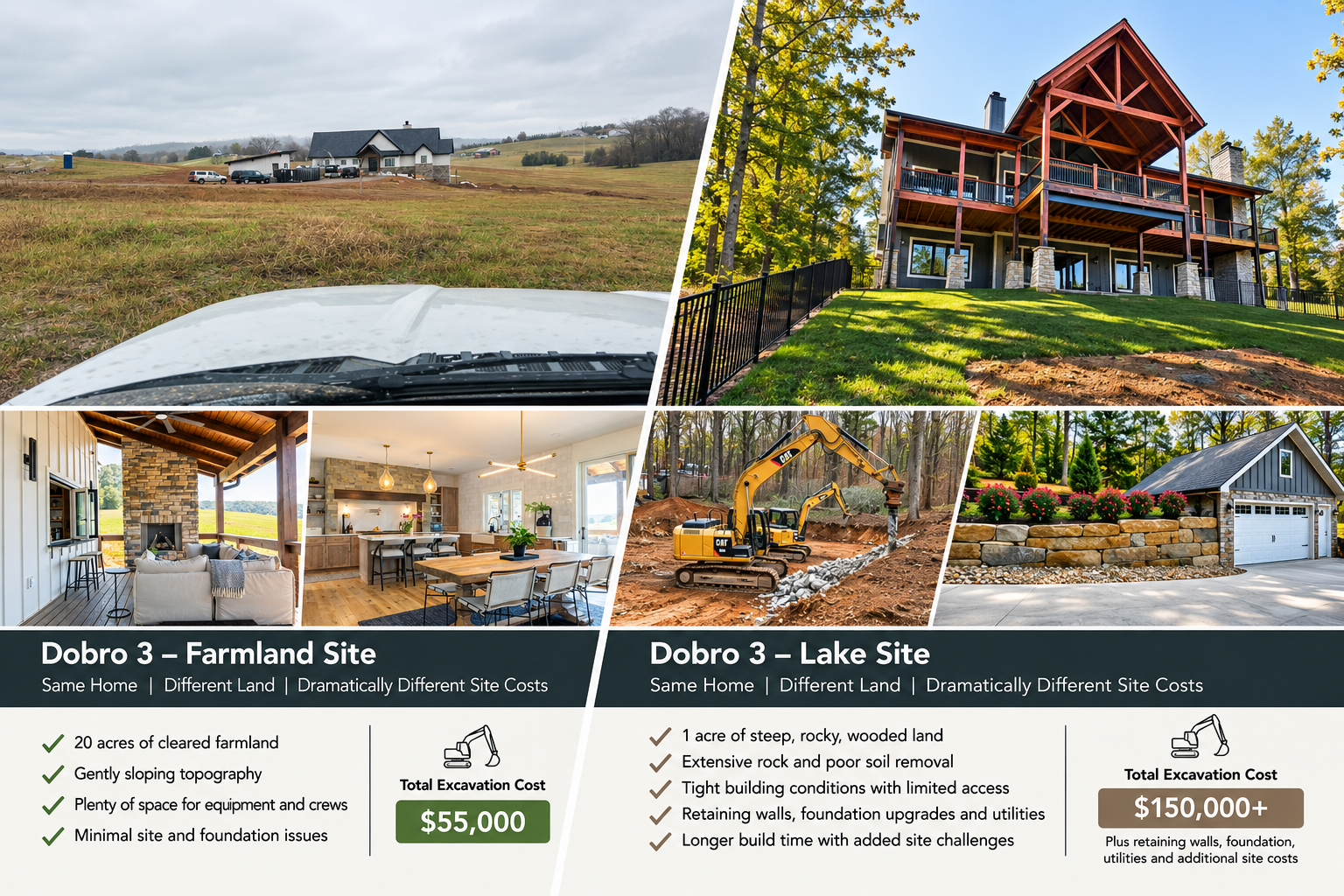
Project 1: Dobro 3, Farmland
Our first example sits on 20 acres of gently sloping, cleared farmland.
From a construction perspective, this property offered several advantages:
- Plenty of space for equipment and material deliveries.
- Easy access for our trade partners.
- Minimal site and foundation complications.
- Sufficient room for multiple crews to work simultaneously.
- Relatively straightforward excavation.
The open site allowed our team to work efficiently without many of the restrictions we encounter on smaller, steeper properties.
Total excavation cost: Approximately $55,000.
View photos of Dobro 3, Farmland
Project 2: Dobro 3, Lakefront
Our second example sits on one acre of steep, rocky and wooded lakefront property.
Although we were building the same home design, the construction conditions were dramatically different.
We encountered extensive rock and unsuitable soil that required removal to prepare the foundation.
Limited access and tight working conditions made it difficult to accommodate equipment, deliveries and multiple crews at the same time.
The property also required retaining walls, additional foundation work and more complicated utility installation.
These challenges extended beyond the initial excavation and affected our construction schedule.
Total excavation cost: Approximately $150,000.
And that figure doesn't include the additional costs associated with retaining walls, foundation work, utilities and the longer construction schedule.
View photos of Dobro 3, Lakefront
What Can We Learn From These Two Homes?
The lakefront property required approximately $95,000 more in excavation alone, nearly three times the excavation cost of the farmland property.
Once you account for the other site-related expenses, the difference becomes even greater.
Neither homeowner necessarily made a better or worse decision. Both chose a property that suited their desired lifestyle.
The important thing is understanding the financial implications of that decision.
4. The Hidden Problem With Cost Per Square Foot
These two projects demonstrate why relying on a generic cost per square foot can be so misleading.
You could build the same house using the same construction methods and still experience dramatically different construction costs simply because of the property you choose.
You haven't added square footage or upgraded your finishes.
You've chosen a different piece of land.
When establishing your budget, you need to understand both the cost of building your home and the cost of developing your property.
Related article: What Does It Really Cost to Build a Custom Home?
5. How to Evaluate a Property Before You Buy
You don't need a complete set of architectural plans to begin understanding the potential costs of developing a property.
However, you do need the right information and the right people involved.
Here are five steps I recommend before purchasing a lake or mountain lot.
Involve Your Builder Early
An experienced custom home builder can walk the property with you, identify potential challenges and help you understand how the land could affect your construction budget.
Obtain a Topographic Survey
Understanding the property's boundaries, elevations and contours helps determine where your home, driveway and outdoor living spaces could realistically sit.
Investigate Soil Conditions
A geotechnical investigation can help identify potential rock and soil challenges.
If your property requires a septic system, investigate soil suitability and system requirements as well.
Understand Restrictions and Utility Availability
Review setbacks, easements, subdivision restrictions, utility connections and applicable shoreline or floodplain regulations.
Some lakefront properties may also be subject to TVA requirements.
Develop a Preliminary Site Plan and Budget
Establish a realistic concept for the location of your home, driveway, garage and outdoor living areas.
Use that information to develop a preliminary site development budget with an appropriate contingency.
When possible, negotiate a due diligence period into your purchase agreement so you have time and permission to complete these investigations.
You may not eliminate every unknown, but you can significantly reduce your financial risk.
6. The Purchase Price Isn't the True Cost of Your Land
When comparing properties, consider the combined cost of purchasing and developing the land.
For example:
Property A: $200,000 land purchase + $300,000 site development = $500,000 total investment.
Property B: $300,000 land purchase + $50,000 site development = $350,000 total investment.
Illustrative figures.
The more expensive lot may actually be the more affordable place to build.
Discovering this after purchasing your property could mean reducing the size of your home, compromising on finishes, eliminating outdoor living spaces or increasing your overall investment.
These are compromises that better planning might have prevented.
Build With Confidence: Before You Buy
Some of the most beautiful homes we've built sit on some of the most challenging properties.
Building on a lake or mountain lot isn't something you should be afraid of. It's something you should approach with knowledge, realistic expectations and careful planning.
At Matt Noss Custom Homes, we believe the builder-homeowner partnership should begin well before construction.
Our Build With Confidence Method emphasizes education, collaboration and detailed planning so you can make informed decisions before making significant financial commitments.
If you're considering purchasing land in the Knoxville area, we encourage you to start the conversation early.
Because choosing the right property isn't just about finding the perfect view.
It's about making sure you can build the home you've always wanted when you get there.
Considering building a custom home in East Tennessee? Explore our Learning Center for more information about construction costs, choosing land, designing your home and finding the right builder.